About Garage Conversion Preston
Garage Conversion Preston is a garage conversion specialist working across Preston and the surrounding towns and villages. We convert garages and nothing else. That focus is deliberate, because a garage conversion looks like a small job from the outside but involves the same structural, thermal and regulatory questions as any other habitable room, and Preston’s genuinely varied housing stock — from Victorian cotton mill terraces to modern estate infill — means those questions have different answers on almost every street.
Who We Are
We are a local firm rather than a national brand working through a regional office. The people who survey your garage are the people who will be working on it, and whoever quotes the job is accountable for that figure when the work is finished.
Preston’s housing is what we know. The red brick terraces built to house the city’s cotton spinning workforce through the nineteenth century, where garages are almost always later additions rather than original features. The post-war and 1960s estates through Fulwood, Ingol and Ribbleton, built with the integral single garage as standard. The genuinely modern developments at Buckshaw Village and Cottam, where trussed roofs and current insulation standards are the norm. Each behaves differently once you open it up, and none of them can be priced from a description over the phone.
That is the practical case for a specialist. A general builder will convert your garage competently. A firm converting garages every week already knows, before the first visit, what is likely to be behind the walls and what bringing it up to a proper habitable standard will actually cost.
What Sets Us Apart
We survey before we quote. Every quotation follows a physical inspection of the garage. We check the slab for damp, assess wall and roof construction, and confirm whether the property sits in a conservation area — Winckley Square, and parts of Chorley and Penwortham, all carry considerations that a standard estate garage does not. A figure produced without those things is a guess, and guesses move upward.
We specify for Lancashire’s rainfall. Damp proofing detail matters more here than in drier parts of the country, and we do not apply a generic inland detail regardless of where the property actually sits.
We design to fire safety standards from the start. A bedroom conversion carries escape window and fire door requirements that an office or playroom does not, and we design for the room’s actual use from day one.
Fixed written quotations. Damp proofing, insulation, Building Regulations submission and making good are all inside the quoted figure. Provisional sums are where domestic building disputes start, and we do not use them to make a number look competitive.
We handle the regulatory side. Building Regulations submission and inspection stages on every job, plus planning applications and conservation area considerations where they apply, and a note to check with the council where a property is or will be a licensed rental.
How We Work
The process is the same on every job, whether it is a basic single garage room or a fully fitted double garage annexe.
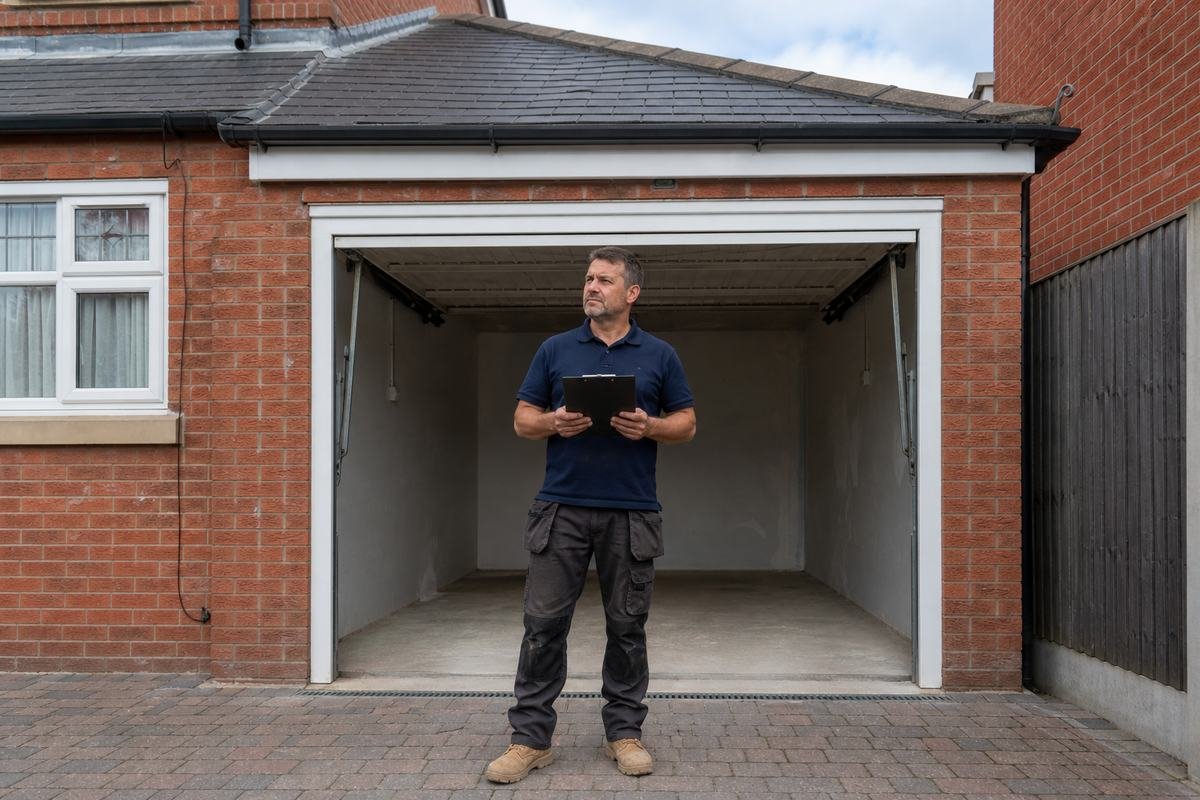
We start with a survey, which takes about an hour and costs nothing. You get a straight answer about what your garage can take and a realistic cost range before any money changes hands.
If you decide to proceed, design and the Building Regulations submission follow, typically taking one to two weeks unless a planning application or conservation area consideration is also involved. On site, work proceeds in the same order every time: structural work and damp proofing first, then insulation, then first-fix electrics, then plastering and finishes. Payments are staged against those milestones rather than taken up front.
The Work We Do
We carry out five types of garage conversion, and which suits your property is determined by the garage and how you want to use the space.
- Single garage conversions — the most common project across Preston’s estate housing
- Double garage conversions — on the larger properties around Fulwood and the newer estates, as one room or split into two
- Home office conversions — a dedicated electrical first fix built for hybrid working
- Bedroom conversions — built to the escape window and fire door requirements a habitable bedroom needs
- Partial garage conversions — keeping tool or utility storage while converting the rest
Our Service Area
We work throughout Preston and the surrounding towns and villages, including Leyland, Chorley, Penwortham, Bamber Bridge and Fulwood.
Each has its own character. Leyland grew almost entirely around its manufacturing history. Chorley spans genuinely historic mill-town terraces and the modern Buckshaw Village development. Penwortham is centuries older than its commuter-suburb identity suggests. Bamber Bridge combines calico works heritage with later estate expansion. Fulwood ranges from Victorian villas to modern infill within a single suburb. Knowing which applies to your property is a good part of the job.
Standards and Compliance
Every conversion we carry out is submitted for Building Regulations approval and inspected through to a completion certificate. That certificate is what a buyer’s solicitor asks for when you eventually sell, and work without one either delays a sale or comes off the price.
Guidance on the standards applying to converted garages, covering insulation, damp proofing and fire safety, is published by LABC.
If you are thinking about converting your garage, the useful first step is a survey. An hour, no charge, and a straight answer about what is realistic on your property.